Portfolio case study
OpsDesk AI
OpsDesk AI is a full-stack, policy-gated AI workflow demo that turns messy service enquiries into structured tickets, retrieval-aware drafts, human approval gates, audit trails, and production-ready integration boundaries.
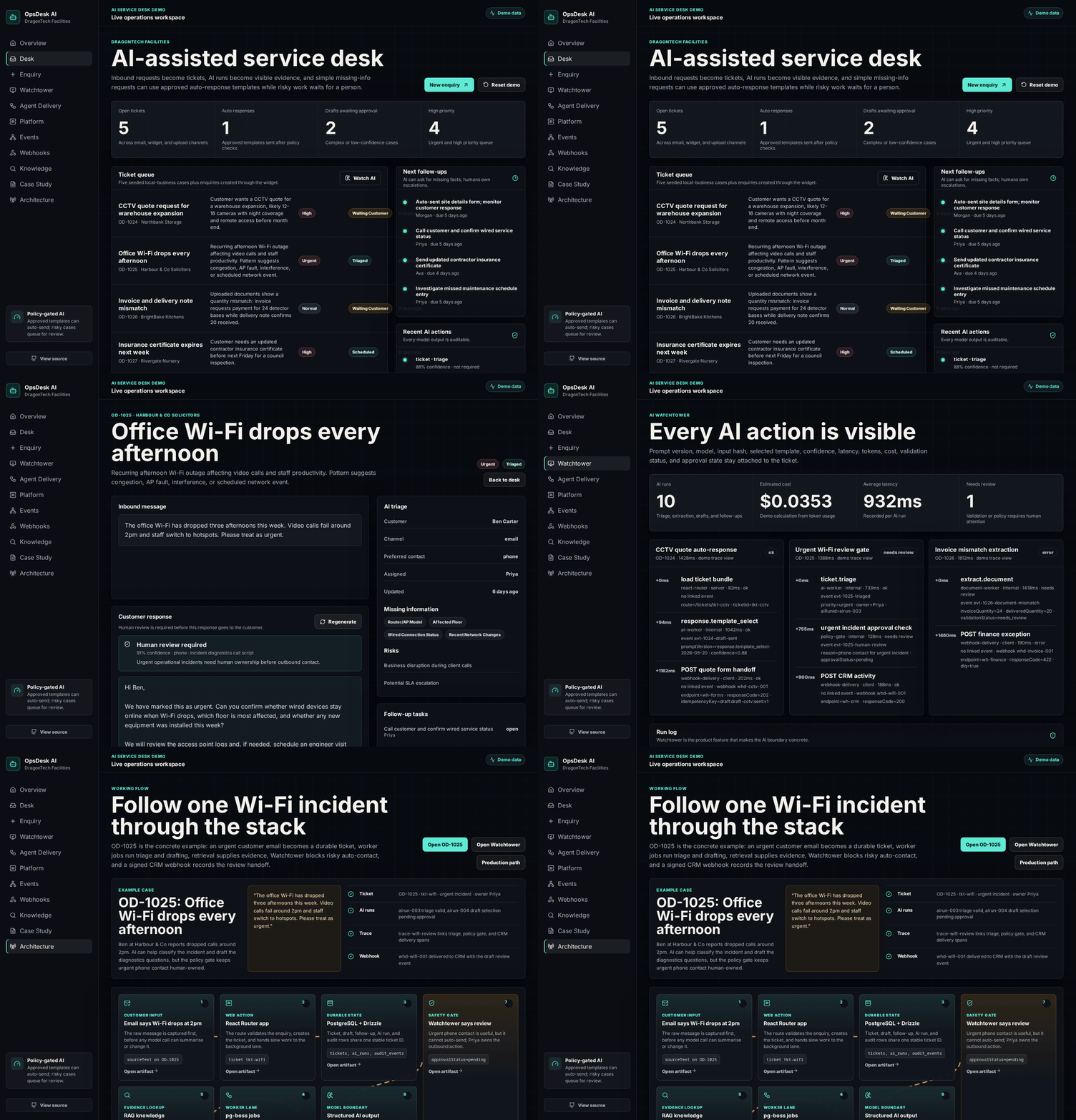
AI handoff loopTicket queue -> review gate -> audit trail
Reviewer path
If you only have a few minutes, follow the workflow in this order.
StartBusiness problem, product story, AI boundary, and production-shaped architecture.Try workflowSubmit a messy customer enquiry and trigger deterministic AI triage.Review queueInspect owners, priorities, summaries, policy status, and follow-up work.Inspect safetyReview prompts, validation, costs, trace spans, approvals, and audit events.Production pathSee hosted demo mode mapped to database, queue, webhook, search, and observability boundaries.
The problem
Local service businesses lose time inside email threads, PDFs, half-written quotes, missed follow-ups, and unclear ownership. A chatbot does not fix that. The workflow needs ticket state, background jobs, human review, and an audit trail that makes AI output inspectable.
OpsDesk AI is framed around DragonTech Facilities, a small operator handling installation quotes, urgent incidents, supplier mismatches, compliance chasing, and customer complaints from the same queue.
Workflow and data model
The core product object is a ticket, not a chat message. Each ticket keeps the raw customer input beside AI summaries, selected templates, policy decisions, events, webhook attempts, and Watchtower trace spans.
That model makes the workflow obvious: intake creates durable state, AI prepares a bounded recommendation, policy decides whether automation is allowed, and the audit trail explains the decision later.
Structured ticketing, AI triage, document extraction, retrieval-aware drafting, human approval gates, and Watchtower audit records.
I designed the workflow, modeled ticket and AI-run data, built the UI and demo flow, defined policy gates, and separated production adapters.
The public demo stays deterministic for reliability while real database, queue, webhook, search, graph, and observability adapters remain explicit boundaries.
Screenshots and GIF
A portfolio page with product evidence, not just claims.
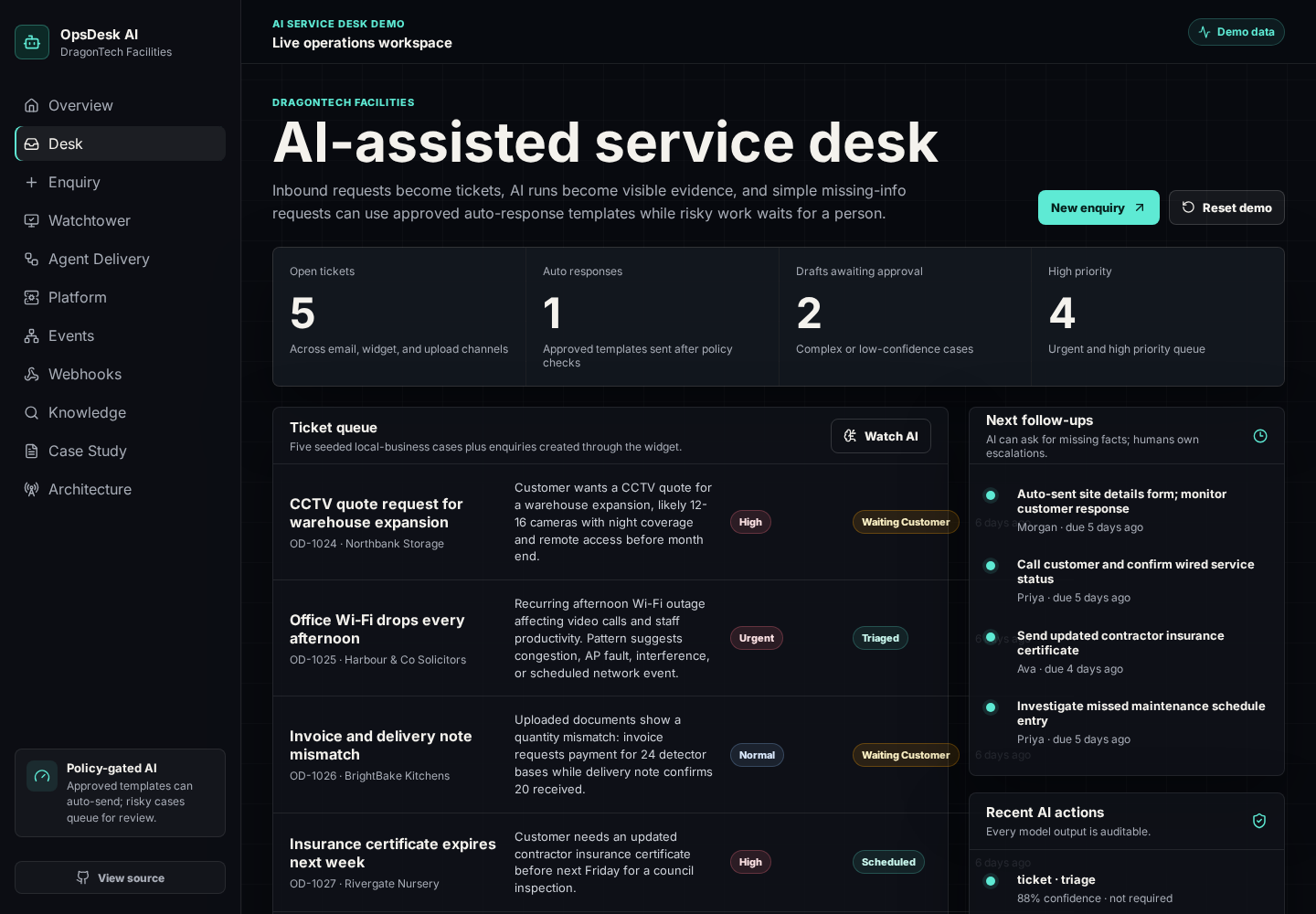
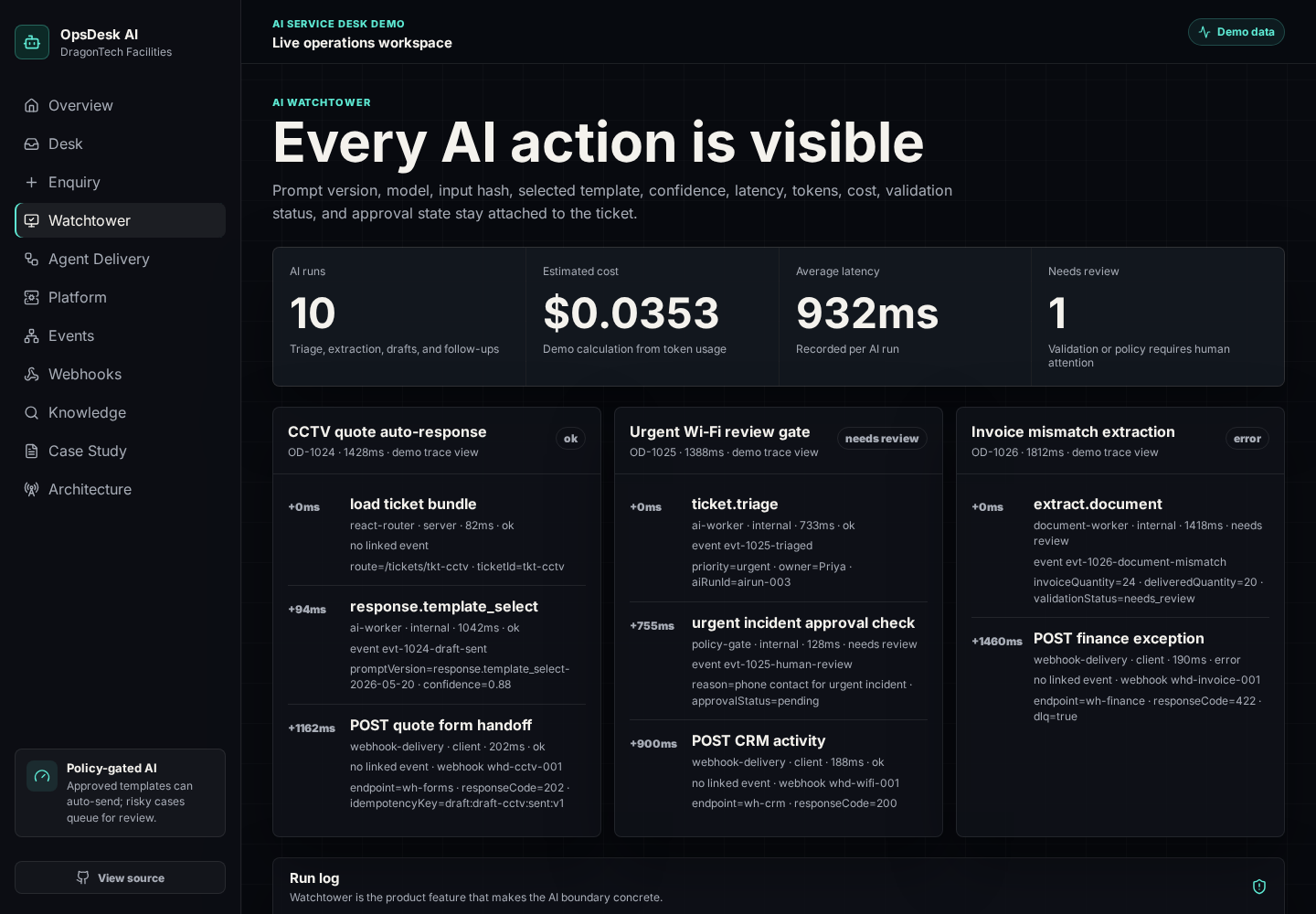
Full-stack implementation proof
Product loop
The product workflow
CaptureWebsite enquiries, email-like messages, and file notes become durable tickets with raw source retained.
TriageAI classifies category, priority, missing info, risk, and the next suggested desk action.
DraftOnly approved response templates can be selected; business commitments stay out of automation.
ReviewPolicy gates route urgent incidents, complaints, mismatches, and low confidence to named humans.
AuditWatchtower keeps prompts, outputs, validation, approvals, trace IDs, tokens, and cost inspectable.
Architecture diagram
The AI path is separated from durable operations state.
The design keeps intake, queueing, AI output, retrieval, audit, and integration contracts explicit, so a reviewer can inspect what happened without trusting a black box.
Human review and audit
AI can prepare work. Humans own risk.
OD-1025 is the clearest story: AI summarises an urgent Wi-Fi incident and drafts diagnostic questions, but the policy gate blocks auto-send because phone contact and customer urgency require a named human owner.
Source retainedRaw email, uploaded note, and extracted document fields stay beside the AI summary.
Policy evaluatedThe gate checks confidence, urgency, category, customer risk, and template permissions.
Human assignedPriya owns OD-1025 because urgent phone contact cannot auto-send from the model output.
Decision recordedApproval, rejection, edit notes, prompt hash, template ID, trace ID, tokens, and cost are logged.
Outcome
DragonTech gets one queue for quotes, urgent incidents, compliance chasing, document exceptions, and complaints. Operators can scan ownership and next actions quickly, while reviewers can inspect every AI decision before trusting it.
The result is a demo that shows the ambiguous business problem, the workflow model, the data model, and the AI boundary on the page instead of hiding those details in architecture notes.
Technical shape
Built as a React Router full-stack app with server loaders/actions, seeded demo state, Drizzle schema for PostgreSQL and pgvector, pg-boss worker scaffolding, AI SDK-ready boundaries, retrieval-aware agent contracts, evaluation tables, and a restrained operations UI designed for repeated use.
The expanded delivery view shows how the project would be sold and adopted with a client team: stakeholder discovery, success metrics, agent blueprinting, RAG pipeline design, rollout controls, and ROI measurement.
This project reflects the same implementation pattern I use in enterprise software delivery: understand the real operational workflow, protect data integrity, automate the repeatable path, keep exceptions reviewable, and design the result so it can be demoed, supported, and extended.